Stop Chasing Job Titles: The 5Ps of Designing Your Future.
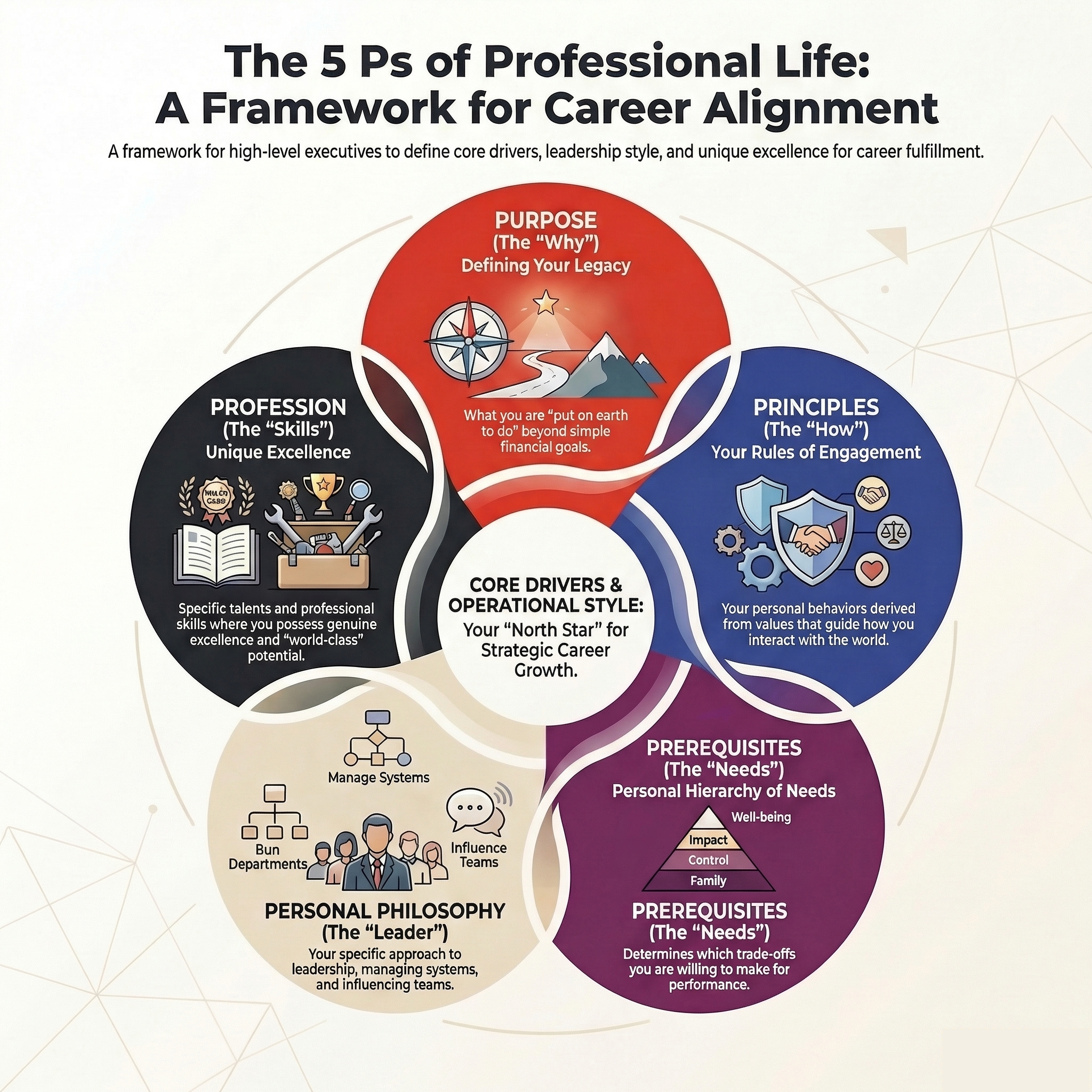
The 5Ps of Professional Life helps you articulate exactly who you are, making it easier to filter out the wrong opportunities and attract the right ones. If you want to stop reacting to the market and start dictating your own path, you need to define these five areas.

Hitting your 40s is a tough time for leaders. Women move toward menopause, men toward what is sometimes called andropause - more commonly characterized as a midlife crisis. Regardless of gender, this period tends to be the time we ask ourselves, "What the heck am I doing?", "Is this all this is?", "Do I want to give the best years of my career to this role?"
My current CEO/ leader coaching base is split pretty much 50/50 male/ female - slightly more women than men right now. And whilst some coachees stick to revenue/growth/AI matters, there are plenty who want to zoom in on designing their future.
When these leaders hit a wall, burn out, or seek their next big challenge, the default reaction is almost always the same. They polish up their resume, reach out to a recruiter, and start hunting for matching job titles. This is a remarkably risky approach. You end up competing for generic roles, hoping the company culture isn't toxic, and essentially letting the market dictate the trajectory of your life.
A far more effective method is designing your career around the 5Ps of Designing for the Future.
This framework helps you articulate exactly who you are, making it easier to filter out the wrong opportunities and attract the right ones. If you want to stop reacting to the market and start dictating your own path, you need to define these five areas.
1. Purpose
Most professionals don't actively think about their ultimate legacy until they are nearing the very end of their careers. But your purpose is the absolute anchor of your professional life. I always run my clients through what I call the "retirement party test". Imagine you are much older, finally retiring, and there is a massive party in your honor. People from all walks of your life are gathered in the room—former colleagues, family members, friends, and neighbors. Someone stands up, taps their champagne glass, and shares three things about the impact you had on them.
What do you want those three things to be? It is highly unlikely they will say, "She was the greatest marketing executive I ever met." Instead, they will talk about your character. They might say you brought your whole brain and an incredible unpredictability to every challenge you faced, or that you were fiercely loyal and always led with your heart. These are the core drivers that make you who you are, whether you are running a boardroom or managing your private life. If you take a future role that doesn’t allow those core traits to blossom, you will inevitably feel unfulfilled and misaligned.
2. Principles
We all have values, but values on their own are just passive ideals. Principles are those values translated into actionable rules of engagement. Almost any decent person will claim that "honesty" is one of their core values. But how does that value actually dictate your behavior?
Imagine you are about to go out for the evening, and your partner asks how they look. If you think their outfit is terrible, an operating principle of "I tell the blunt truth no matter what" might lead you to say exactly that, completely destroying their confidence. A different operating principle built on the exact same value of honesty might be: "I never lie, but I always find a way to deliver the truth so that it uplifts the other person".
You can build a highly successful business operating out of fear and cutthroat tactics, or you can build one by putting human psychology and well-being first. Both methods can technically win the market, but they represent entirely different principles. You must define your rules of engagement. Doing so allows you to stress-test future opportunities. If you join a leadership team whose principles clash with yours, you will experience daily friction and ultimately fail to do your best work.
3. Prerequisites
This is your personal hierarchy of needs. To find the right role, you have to make hard, ruthless choices about what matters most, and in what exact order. If you imagine your needs as a pyramid, you might assume "family" naturally sits right at the base. But is that strictly true based on how you actually operate?
Consider a highly ambitious executive I once worked with. We discovered that her deepest drive was to have massive, systemic impact on the world. Right below that was her desire to build a family. Interestingly, "having fun at work" was the least critical - she was entirely willing to sacrifice a fun, easygoing environment if she could achieve her primary goal of impact. Because she understood her hierarchy, she knew that taking a lower-stress job without real influence would eventually make her miserable, even if it gave her more free time.
You have to rank your non-negotiables—whether that is total control over decision-making, financial upside, flexibility, or global impact. If you refuse to rank them, you will end up accepting the wrong compromises and resenting the sacrifices a role demands.
4. Personal Philosophy
When an interviewer asks the classic question, "Tell me about yourself," 99% of candidates boringly recite their chronological work history and read off their online profile. They will say, "I started in sales, then I moved to this company, then I became a VP..."
You can immediately stand out by explaining your leadership philosophy instead. You might say, "You’ve seen my resume, so rather than repeat it, let me tell you how I lead teams and the framework I use to drive predictability".
Great leaders don’t just stumble into success; they have a definitive philosophy. Think of elite sports managers. When they take over a struggling team, they don't just tell the players to run faster; they implement a specific, rigorous system for how the game must be played. What is your system? How do you view the gap between strategy and execution? Having a clearly defined philosophy demonstrates deep self-awareness and immediately separates you from the pack. It proves you aren't just an operator, but a true strategic leader.
5. Profession
Finally, we get to your actual functional skills. What are the specific, elite competencies you possess? To figure this out, I use the "Three Buckets of Capability" analogy.
Imagine every task you do falls into one of three buckets. Bucket one holds the things you are genuinely great at—your 7/10 or 8/10 skills. Bucket two holds the things you are poor at—your 2/10 skills. Bucket three is what I call "putting the bins out" - the mandatory, boring administrative chores we all just have to do to keep life running.
Most professionals waste a tragic amount of energy focusing on bucket two. They agonize over their weaknesses, trying to drag a 2/10 skill up to a mediocre 3/10. This is a huge mistake. To achieve elite performance, you must invest heavily in bucket one. Turn your 7/10 into a world-class 10/10. If you are terrible at building presentation decks but brilliant at verbally strategizing, don't force yourself to spend weeks staring blankly at presentation software. Partner with someone who excels at design, and focus your entire intellect on the strategy itself. Your professional capability is defined by leaning relentlessly into your unique superpowers, not by struggling to fix your inherent weaknesses.
Bringing these 5Ps together gives you a definitive, personalized blueprint for your career. It provides you with the courage to turn down the wrong jobs, even when they pay well, and makes you highly desirable to the organizations that truly align with how you operate. You stop letting the market decide your future and start proactively designing a career where you can truly do your most brilliant work.
If you would like to work through any of these challenges with one of the team or me, drop me a line at pete@petecrosbyrevenue.com .